There is a day in late March when the world is exactly halfway between darkness and light. Not leaning toward either. Just — balanced. The sun rises due east, sets due west, and for one turn of the clock, day and night hold equal ground. This is the Spring Equinox, and it has had a name for a long time: Ostara.
The word comes to us from the Old English Ēostre, a goddess of spring whose name the eighth-century monk Bede recorded in his chronicle of the English months. April, he wrote, was once called Ēosturmōnaþ — the month of Ēostre — and Christians in his time had begun filling it with a new festival while the old name remained. Whether Ēostre was a widely worshipped deity or a local figure whose memory lingered only in a month's name, we cannot say with certainty. What we can say is that her name survived, and the associations that gathered around it — eggs, hares, dawn, the return of warmth — proved durable enough to outlast entire eras.
What the Equinox Actually Is
The Spring Equinox (also called the Vernal Equinox) occurs when the sun crosses the celestial equator moving northward, typically between March 19 and March 21. In 2026 it falls on March 20. At this moment, the tilt of the Earth's axis is perpendicular to the sun's rays, and the division of day and night becomes as close to equal as it ever gets — roughly 12 hours each, at every latitude.
For agricultural peoples tracking the year by what the sky was doing, this was a moment of genuine practical importance. After the equinox, days grow longer than nights in the Northern Hemisphere. That crossing point — the tipping from one half of the year into the other — was worth noticing, worth marking.
In the old Germanic calendar, the month corresponding to late March and early April was named for Eostre. It was the beginning of the growing season, the time when cattle were driven back to pasture and seeds went into still-cold ground. The festival associated with this month was not an abstraction. It was anchored in something farmers could see happening every morning: the light coming back earlier, and staying later, day by day.
The Goddess Eostre and Her Symbols
Beyond Bede's brief mention, we have almost no direct historical record of Eostre as a deity. Jacob Grimm, in his nineteenth-century collection of Germanic mythology, proposed an equivalent continental goddess — Ostara — and noted linguistic similarities between her name and words for dawn and east across Indo-European languages: the Old High German ōstar, the Latin aurora, the Sanskrit ushas. All pointing, literally, toward the direction from which light comes.
This is worth sitting with. A goddess whose name means east, whose festival falls when the sun rises exactly in the east, whose season is the one when days start being born earlier each morning. The name and the moment fit each other like a key.
The hare appears in connection with Eostre in Bede's account, and in later folklore about Easter (a name also derived from Ēostre). Hares were associated with the moon in many cultures — they were active at dusk and dawn, the liminal times — and with spring fertility more broadly.
The most widely known legend tells it differently. One year Ostara arrived late — winter lingered past its time because the goddess had overslept. The first thing she found when she finally reached the frozen world was a small bird lying on the ground, its wings locked in ice, dying of cold. Ostara cradled the bird and breathed warmth over it, but its wings were too far gone to be healed. So she transformed it instead — into a white snow hare, swift-footed and quick enough to outrun any hunter. She named him Lepus. And in memory of his former bird nature, she gave him one gift carried over: the ability to lay eggs. Once a year, at the spring equinox, he would lay coloured eggs and give them away to children at Ostara's festival.
The legend was first recorded in Germany in 1883 and has no direct ancient sources — it is more neopagan than pre-Christian. But it captures the festival's logic precisely: a creature that carries a bird's nature inside an animal's body is a threshold being, a guardian of the boundary between winter and spring, darkness and light.
In Celtic and Germanic tradition, hares were widely regarded as shape-shifters — they could vanish with a speed and silence that, to older minds, meant only one thing: this creature knows the paths between worlds. Hunting hares was taboo in some regions; it was said a witch or spirit might be wearing the hare's form. The three hares sharing a single ear apiece, running in a circle — an ancient motif found from China to Cornwall — remains unexplained by historians.
A hare running through a spring field is an image of the season itself: quick, watchful, uncatchable.
Eggs as a symbol of spring renewal are far older than any particular tradition. The egg contains an entire living creature in potential. It is a winter object — laid quietly and carried — that cracks open in warmth. Decorating eggs at the Spring Equinox appears in many unrelated cultures, which suggests that the symbolism didn't travel from one place to another so much as it arrived independently, wherever people were watching eggs hatch in spring.
Ostara in the Wheel of the Year
In the modern Wheel of the Year — the cycle of eight festivals observed in various contemporary pagan and nature-based traditions — Ostara sits at the midpoint of spring. It is flanked by Imbolc (early February) on one side, when the first signs of returning light appear, and Beltane (early May) on the other, when the full warmth of the season arrives. Ostara is the hinge between them: past the earliest stirrings, not yet arrived at abundance.
As a festival of balance, Ostara holds a particular quality that the other solar festivals don't quite share. The solstices are extremes — maximum light, maximum darkness. The equinoxes are thresholds. They don't celebrate what already is; they mark a turning. At the Spring Equinox, the balance tips, and after this day it tips further toward light every single morning.
The Colours of Ostara
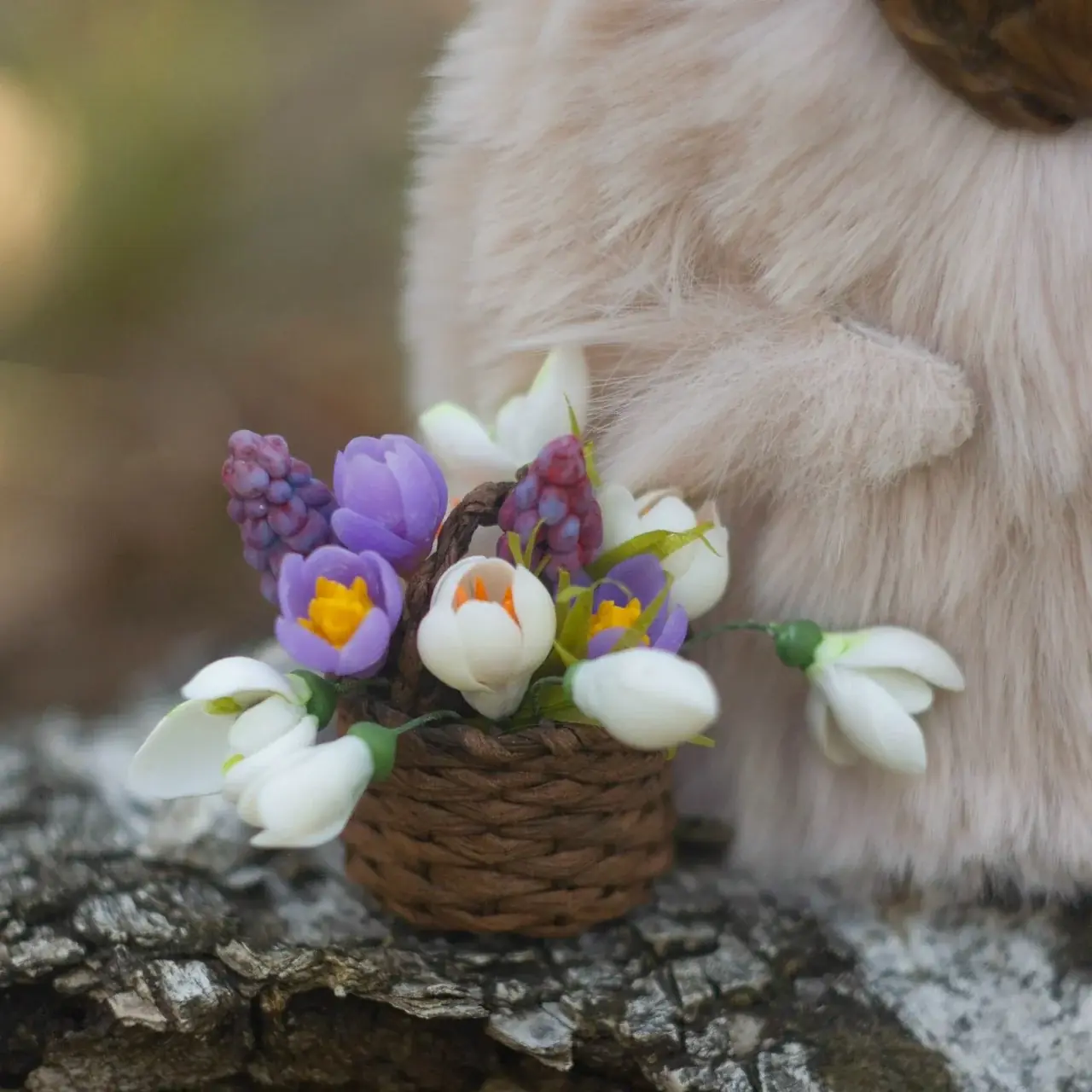
The traditional colours of the festival are pale, like the first light after winter. Soft yellow and gold — the returning sun. Tender green — the first shoots pushing through cold soil. White and cream — snowdrops, early warmth. Purple and lavender — crocuses, the first vivid colour after winter's grey. Blue — the equinox dawn sky, exactly as it looks on March 20 when the sun rises precisely in the east.
How Ostara Was Celebrated
Because written records from the pre-Christian Germanic world are sparse, we reconstruct Ostara's observance partly from folklore, partly from the persistence of certain practices that clearly predate the Christian calendar's appropriation of spring. Some things we know or can reasonably infer:
Fire and light. The return of the sun was welcomed with fire — bonfires on hills, candles in windows. The idea was participatory: you added your own light to the growing light of the season. You did not passively wait for spring to arrive; you met it.
Eggs. Decorated eggs as spring gifts appear in the archaeological record well before the Common Era. The practice of painting or carving eggs at the spring festival is likely one of the oldest surviving folk traditions in the Northern Hemisphere. In the Slavic tradition, pysanka — elaborately patterned wax-resist eggs — were made for spring and the symbols on them were explicitly solar: spirals, stars, crosses representing the four directions of the sun's path.
Seeds and planting. Ostara was a practical occasion. The equinox was used as a guide for when to plant — certain crops went in around this time, others after the next full moon. The ritual of burying seeds in the ground was understood as more than agricultural; it was an act of trust, of committing something living and fragile to the cold dark and believing it would return changed.
Clearing and opening. Spring cleaning — in the literal sense of opening the house after winter, airing out bedding, washing walls — was part of the festival period. This was not just housekeeping. It was the same gesture as the season itself: clearing out the accumulated weight of winter to make room for what was coming.
The Spring Equinox and Ostara's Breath
When I began working on a creature to embody the Spring Equinox, I wanted something that held the specific quality of this moment — not the exuberance of full spring, but the earlier thing. The held breath before the plunge. The crocus coming up through snow that hasn't quite finished.
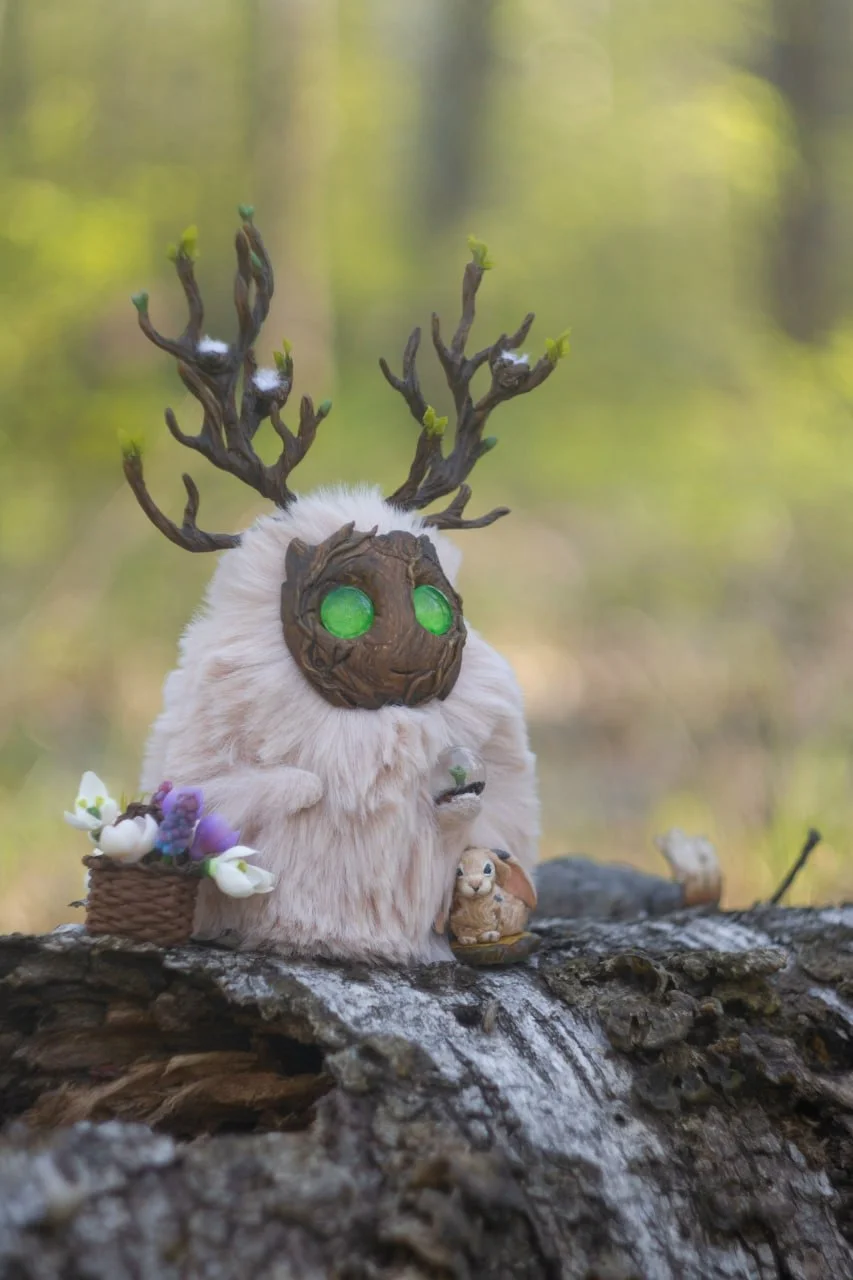
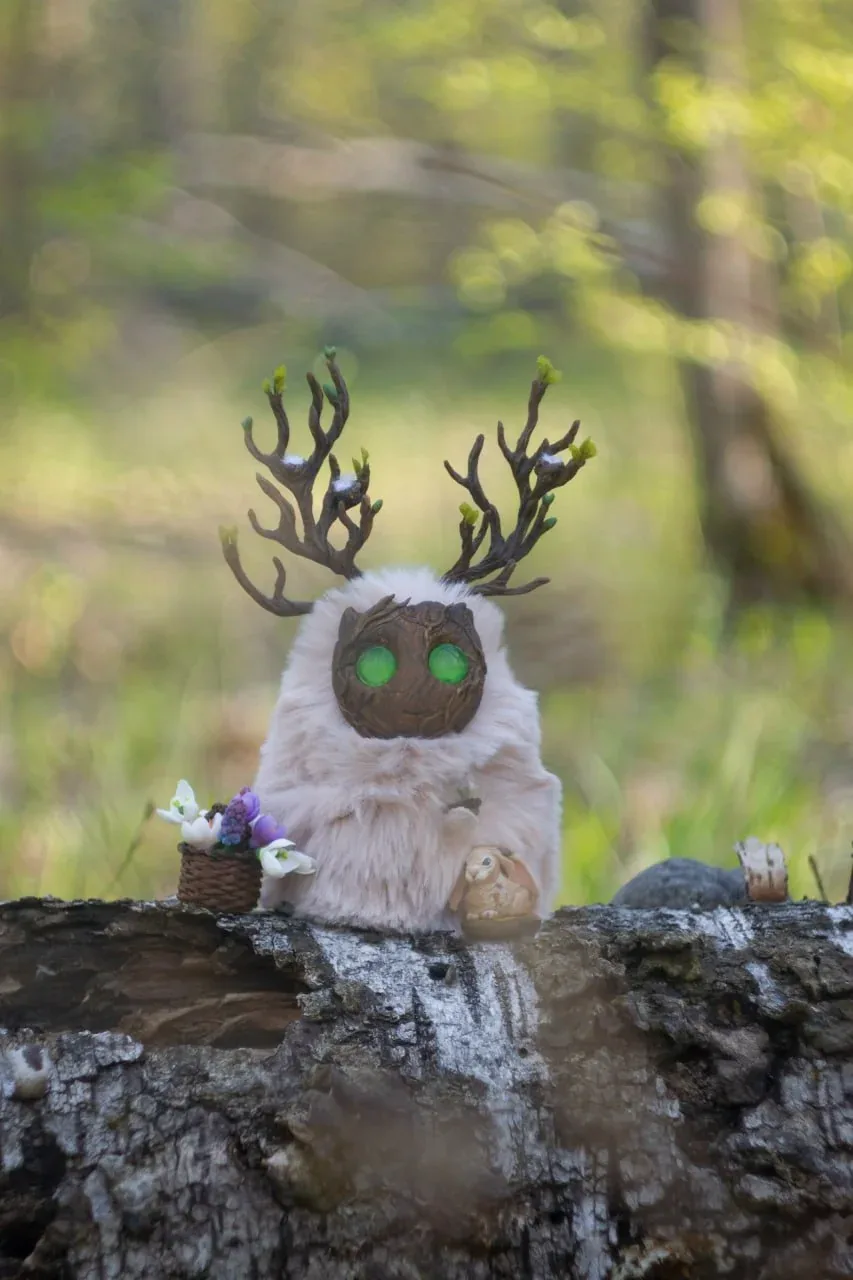
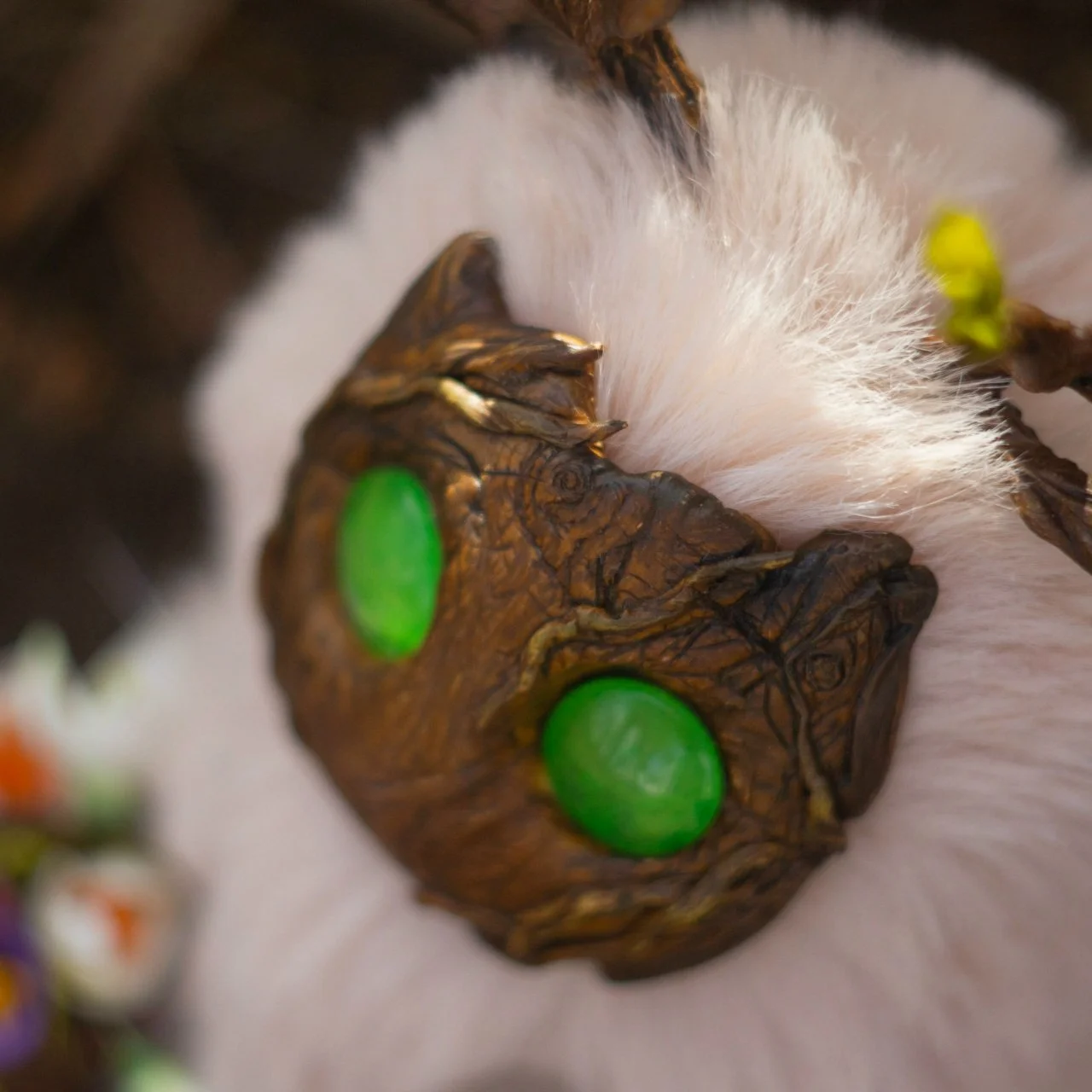
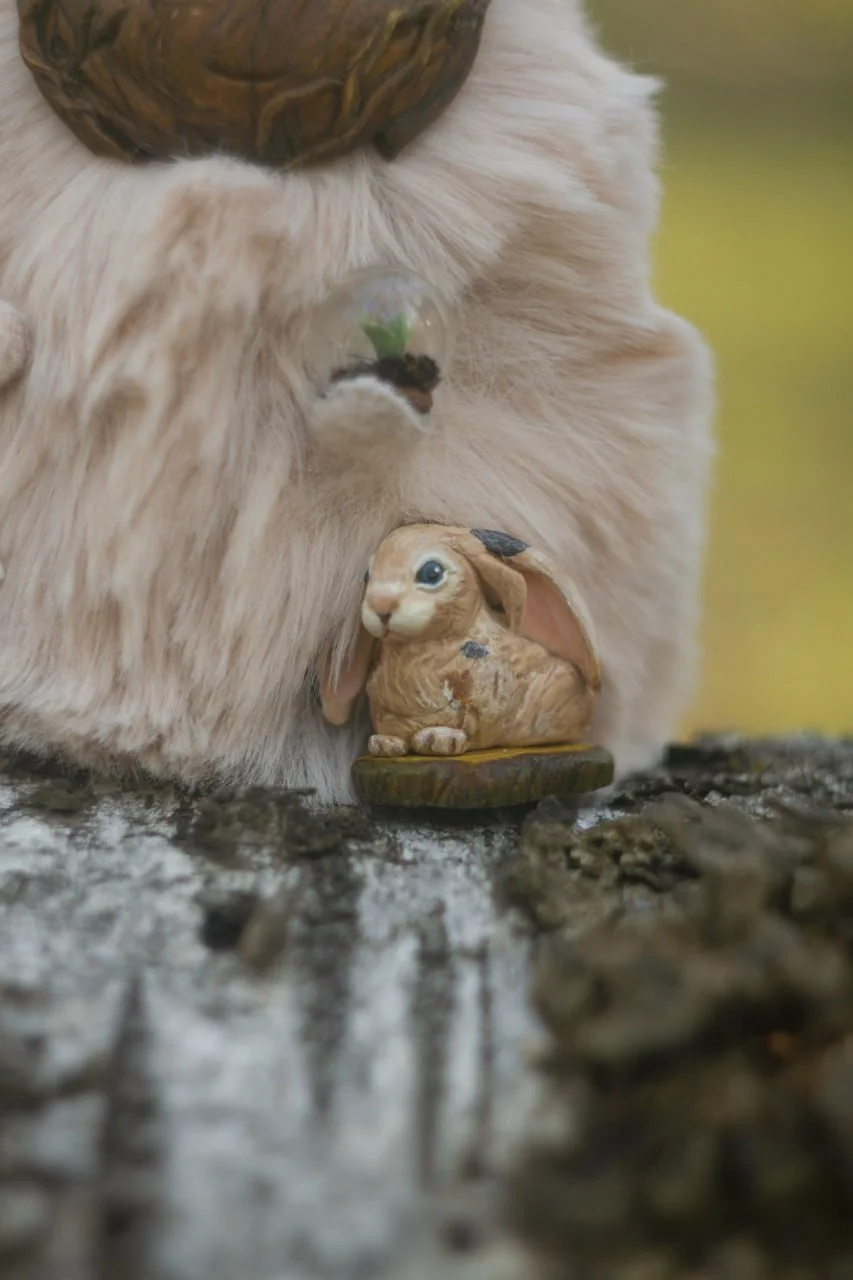
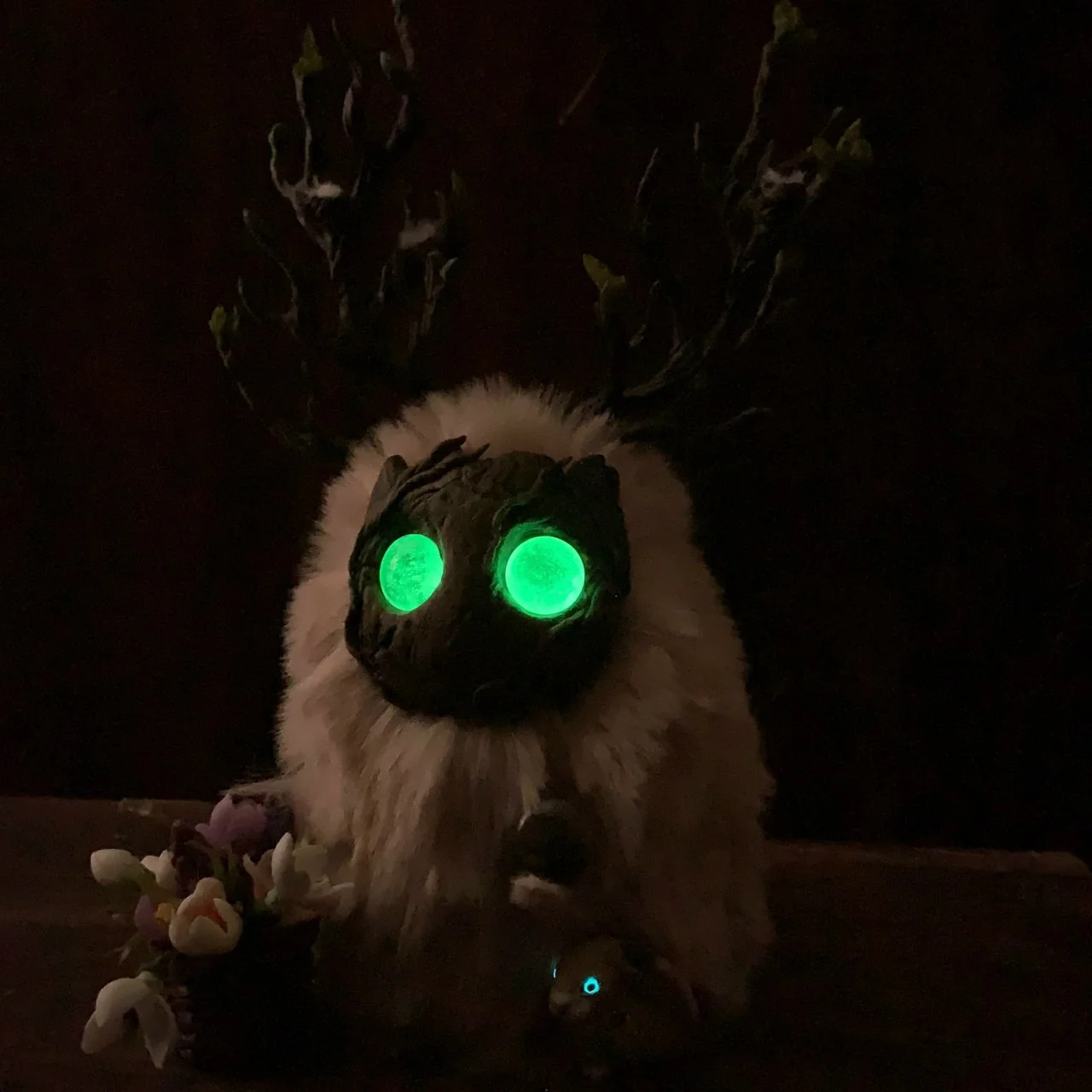
Wood Spirit Ostara's Breath carries a glass orb with a single green sprout inside — not a flower yet, just the beginning of one. The antlers are budding: bare wood putting out the first small leaves, with two birds' nests settled in the forks. The basket holds snowdrops and crocuses, the flowers that come up before it's sensible to come up. And at the base of the birch log, the hare sits — alert, patient, waiting for whatever comes next.
Each of these elements is a different way of saying the same thing: something is starting. Not started. Starting.
What to Do at Ostara: Rituals, Traditions and Customs
Ostara is an active festival — a time of doing, not just remembering. Here are the practices, old and new, that belong to this threshold day.
What is customary to do
Decorate eggs. This is the oldest and most universal Ostara tradition. Hard-boil eggs and paint them with spring symbols — spirals, flowers, hares, suns, and crosses representing the four directions. Natural dyes from onion skins, beets, turmeric and red cabbage are traditional and make beautiful, lasting colours.
Light a candle or fire at sunrise. Wake early on the equinox and light a candle or go outside to watch the sun rise exactly in the east. This is the participatory heart of the festival: you add your own small light to the growing light of the season. Even a single candle on the windowsill counts.
Plant plants. Ostara is the traditional time to start seeds — indoors in pots if the ground is still frozen, directly in the earth if the season has arrived. The act of pressing a seed into soil is itself a ritual: an act of trust that what you commit to the dark will return changed.
Spring clean. Opening the house after winter — airing out bedding, washing windows, clearing clutter — is one of the oldest equinox customs. The idea is the same as the season itself: clear out accumulated winter weight to make room for what is coming.
Take a sunrise walk. The equinox sunrise is worth seeing. The sun rises exactly due east on this day — the only days of the year when that's true are the two equinoxes. Find an unobstructed eastern horizon and watch.
Traditional food
Ostara food is light, green and egg-forward. Eggs in every form — devilled, painted, dyed — are central. Spring herbs that have just come up: chives, sorrel, wild garlic, nettles (blanched). The first green shoots: asparagus if it's available, green onions, radishes, spinach. Honey-based sweets are traditional in many cultures — honey cake, mead, or warm honey stirred into spring herb tea. Bread shaped like animals — hares especially — appears in German folk tradition. Pancakes with fillings. Dairy in fresh forms: soft cheese, butter, cream.
Why the Equinox Still Matters
There's a version of this question that asks whether old festivals have any relevance now that we don't depend on the agricultural calendar, don't need to know when to plant, don't watch the sky to understand the season. And the honest answer is that the equinox hasn't lost its relevance at all — we've just stopped paying attention to it.
The days still get shorter in autumn and longer in spring. The light still changes. The equinox is when that begins to be noticeable.
Marking it — with a decorated egg, a walk to watch the sunrise, a meal with spring herbs, a new plant on the windowsill — is a way of being in the year rather than passing through it. It's the difference between watching spring happen and meeting it.
The equinox doesn't ask you to believe in anything. It asks you to notice something: that on this one day, the light and the dark are the same length, and after today, the light wins a little more each morning.